CUPID'S ARROW
The Ensign Cupid Camera
I wonder if like me you have ever considered how the Ensign Cupid came to have such a distinctive design? The gun sight finder coupled with its unusual T shaped body make it stand out from the crowd. Why would anyone design such an awkwardly shaped hand camera?
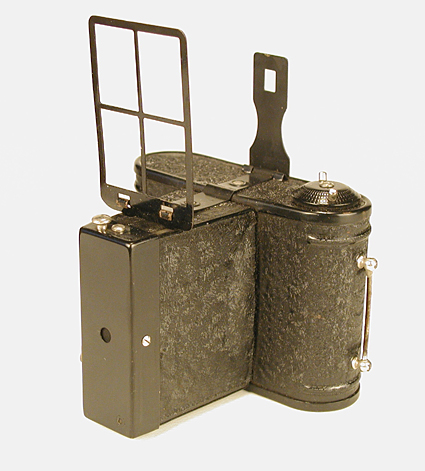
The answer came to me quite by chance while sifting through some patent specifications. In a patent application from the Houghton-Butcher Manufacturing Company Ltd., with a rather uninspiring title 'Improvements in or relating to Photographic Cameras'. I was surprised to find a camera that I instantly recognised to be the Ensign Cupid.
Closer inspection of the specification drawings revealed however that there was a significant difference between the Cupid we know today and the subject of the patent. On reading the text, I discovered that this camera was designed to use plates or sheet film and not roll film. British patents apply only to the specific features as described in the specification text and this application was for a system that could enable the user to take, and I quote from the patent "a plurality of different small pictures (say three) to be taken separately upon a standard plate" the system worked by moving the plate laterally across the film plane of the camera after each exposure using guides that folded so that the camera could be collapsed to a convenient size for carrying. This patent related only to these features, the drawings serving only to illustrate their potential use.
The provisional patent was applied for by Alfred Joseph Dennis General Manager and Valentine William Edwards Departmental manager of the Houghton Butcher Manufacturing Company Ltd., on the 6th of December 1921 with the complete specification left on the 5th of September 1922, the latter being granted British patent No. 193,986 on the 6th of March 1923. As can be seen from the drawings and an accompanying paragraph in the text, the specifications include a detailed description of the finder design that we associate with the Cupid as it later went into production. In addition, the text briefly describes the guillotine shutter which also became a feature of the later production model. Though neither of these features form part of this patent.
I thought this design for a folding hand camera using plates was rather old fashioned even for the early 1920's and began to wonder if this could be the reason why the design came to be adapted later to use roll film? In the hope that they would help me find the answer I sent off for copies of the other patents that applied to the Ensign Cupid as listed on the body of the camera. These being patent Nos. 194,897 of 22nd March 1923 and 207,637 of 6th December 1923. About a week later the envelope from the patent office dropped through my door. The first patent, No. 194,897 was for "Improvements in or relating to Roll Film Photographic Cameras having Rigid Bodies." It was again applied for by Alfred Joseph Dennis General Manager and Valentine William Edwards Departmental Manager on behalf of the Houghton Butcher Manufacturing Company Ltd. The drawings that accompany the text recognisably show the Ensign Cupid as it later went into production minus its frame finder. In fact, in the complete specification there is a paragraph that states;
"In these drawings A represents the main body
or box part of the camera carrying the usual
lens, shutter mechanism, viewfinder, etc. all
of which are omitted from the drawing as they
form no part of the invention."
The patent relates to the shape of the body of the camera and its light tight construction using sheet metal. Further reading partly answers my original question in this article, 'Why would anyone design such an awkwardly shaped camera?' to quote from the specifications;
"It will thus be seen that a roll film
photographic camera body can be easily and
cheaply constructed according to this
invention which will be of smaller general
dimensions and more compact form and
attractive appearance than the usual or known
rectangular box type of camera body whilst
maintaining the necessary light-tightness of
the joints when the parts are assembled."
Clearly from this extract we can see that Houghtons hoped this design would be an improvement on the common box camera and that its small size and novel design would be a selling point rather than a disadvantage, even though, in my opinion, it was arrived at more by accident than intention. The original plate model folded down to a very convenient size for the pocket but once a compartment for roll film was fitted this neat little plate camera became little more than an odd shaped box camera.
One of the more unusual features of the Cupid is its shutter, rather cheap and cheerful but effective and this shutter was the subject of the second patent I received. Patent No. 207,637 called "Improvements in or relating to shutters for photographic cameras.". Once again applied for by Dennis and Edwards, it describes four shutter designs, the common factor between them being the use of a Zigzag or tortuous guide way to control the shutter speed. Figures 1,2 and 3 of the patent drawings show the construction of the guillotine shutter as fitted to the production model of the Cupid.
While looking at these patents I remembered that I had seen a photograph of a stereo camera claimed to be a prototype for the Cupid in a book by Cyril Permut called, 'Collecting Old Cameras'. I checked and sure enough there was a photograph with a short note that this was the prototype camera. I also remembered that in 1988 the Permut collection had gone for sale at Christies of South Kensington. I looked out the sale catalogue and found that Lot 275 had been catalogued as a " Prototype stereoscopic Ensign Cupid....and an Ensign Cupid camera (2)." The description further stated;
"The original patent for the stereoscopic prototype was granted on December 6, 1921 (No. 193986) to the Houghton-Butcher manufacturing Co. Ltd., A.J. Denniss and V.S. Edwards. The patent allowed for a series of exposures (not necessarily stereoscopic on one plate)."
However as can be seen from Fig.1 there is nothing stereoscopic about the camera in the patent specification drawings nor any mention of stereo pairs in the associated text. I decided my best course of action was to consult an expert, so I rang my friend Michael Pritchard the then camera specialist for Christie's of South Kensington, London to ask if he had any further information regarding the prototype camera. This proved to be the right course of action. Michael informed me that the prototype camera had been sold together with an example of the production model Cupid at the Christies sale of November 10th, 1988, for £605 including buyer’s premium. Included in the lot were two documents relating to the design of the camera.
The first document was a copy of the original patent which I have already described to you. The second document however was a personal letter from V. W. Edwards to Cyril Permutt explaining how the prototype stereo camera came into existence. Edwards was in charge of the Experimental department of the Houghton-Butcher Manufacturing Co. Ltd., Walthamstow at the time the Cupid was developed. He writes;
"This hand-made, somewhat crude, test model is a stereo' version of a camera designed to take more than one picture on a single glass plate.
It was devised by the writer and was the subject of Patent no. 193986 of 1921 - the camera illustrated in the specification was intended for single (panorama) pictures i.e. NOT stereo' the latter being a follow-on from the single-picture version - 'twas for use with metal dark-slides and designed to take two stereo' pairs on a 1/4 plate, the exposures being made successively with the dark slide inserted in the camera firstly one side and then the other.
A model was also made for 3 1/2 x 2 1/2 plates, this one took THREE stereo pairs on each plate, the dark slide being successively slid to three positions as shown in the specification quoted above. For picture sizes see the accompanying stereo' slides - the larger one was actually taken with the crude camera herewith, and the small one with the 3 1/2 x 2 1/2 model mentioned, unfortunately all I can find of this one is the viewfinder frame herewith. Regretfully, the project never got beyond the experimental stage."
The letter is signed by Edwards. Unfortunately, the slides mentioned in the letter appear to have disappeared. It would have been very interesting to see what results were obtained with such a camera. So, the facts began to fall into place, the discovery of this letter answered my second question as to which camera came first. We can now see that the camera was in fact first designed for three single exposures on a plate followed by two experimental stereo models, finally being redesigned to use standard roll film.
Most people find the Cupid notable because it was the first sixteen on 120 camera. Although it was never advertised as such. When introduced late in 1922 the Cupid was advertised in Houghtons Ltd. catalogues as a camera giving "12 pictures for the price of six". A standard 2 1/4B roll film normally giving six 2 1/4 x 3 1/4-inch pictures per roll. Houghtons achieved this by adapting an idea patented by William Henry Harvey in 1914 (Patent No.13246). It describes how you can adapt a roll film camera to provide twice as many exposures by inserting a mask and providing an extra red window. It also explains how the use of roll film marked with two sets of numbers could be used to provide accurate
spacing of negatives when using a mask in a roll film camera.
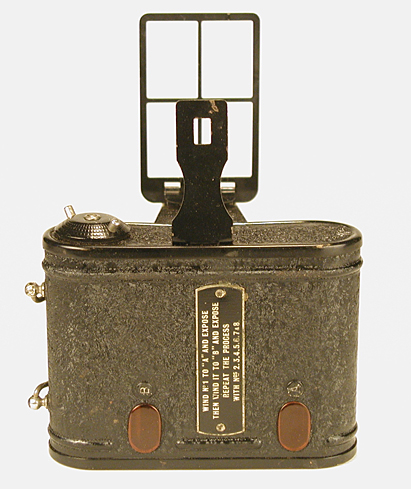
The Cupid was provided with two red windows spaced exactly as to allow enough travel on the film for two exposures of 2 1/4 x 1 1/2 inches to be made in the space for one 2 1/4 x 3 1/4-inch picture. Number 1 on the backing strip was wound into window A and the first exposure made then the same number was wound until it showed in window B when the second exposure was made. This procedure was repeated with numbers 2 to 6. thus allowing 12 exposures to be made on a standard six exposure roll film (See photo x).
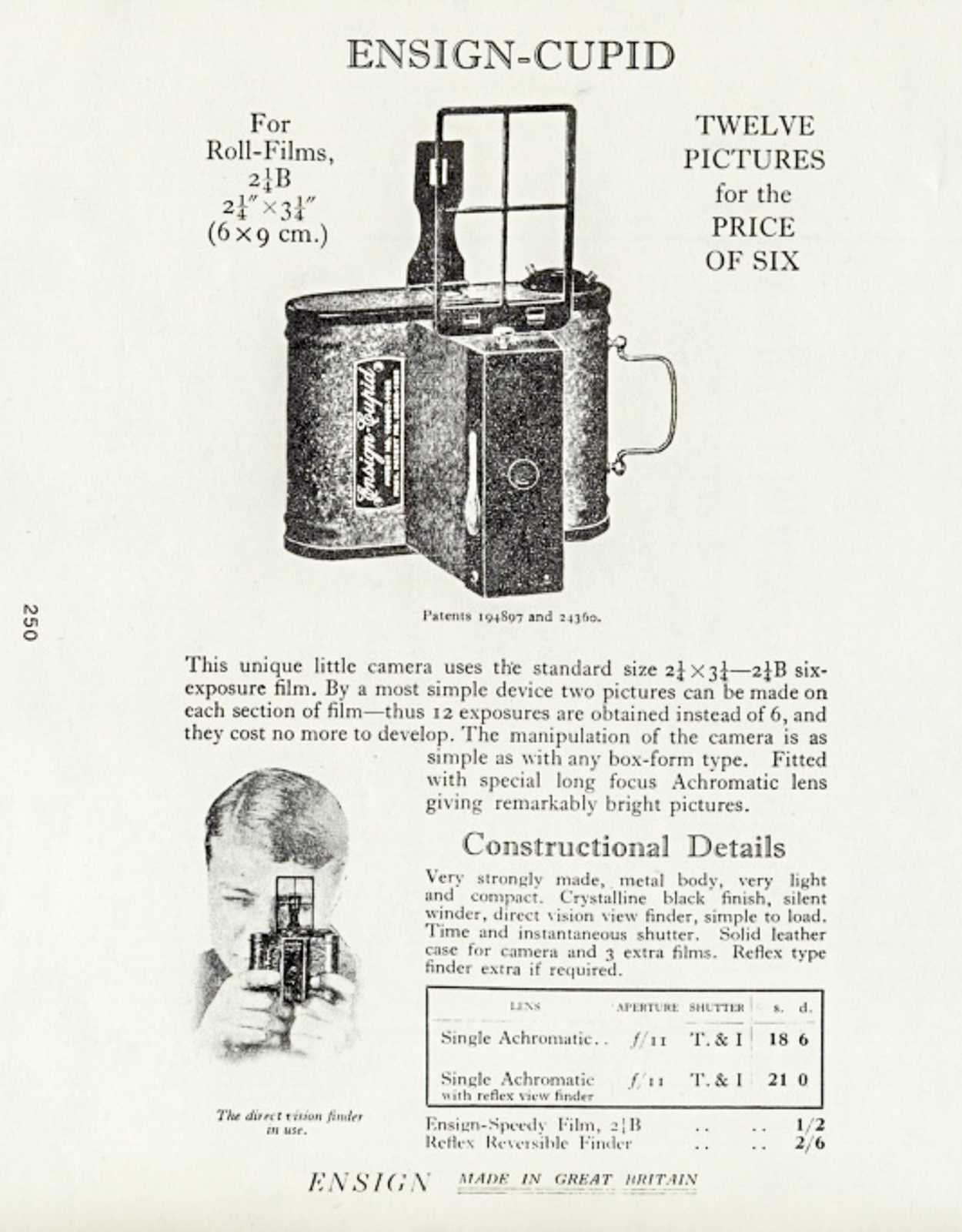
Towards the end of 1929 Houghton-Butcher (GB) Ltd., introduced E20 roll film which gave eight 2¼ x 3¼ exposures on one film, this development enabled the Cupid to take 16 pictures on one roll of E20 film. (Photograph x2) shows the back plate of a late model with instructions for roll films giving eight exposures. Strangely the Cupid is not listed in Houghton-Butcher catalogues after 1928 and nowhere is it described as a 16 on 120 camera. I say strangely because later models have back plates marked for eight exposure film which as I have already commented, I believe was not introduced by either Kodak or Houghton-Butcher until late 1929 early 1930. This leads me to believe that although the Cupid was no longer listed in Ensign catalogues post 1928, cameras were probably still being produced after this date.
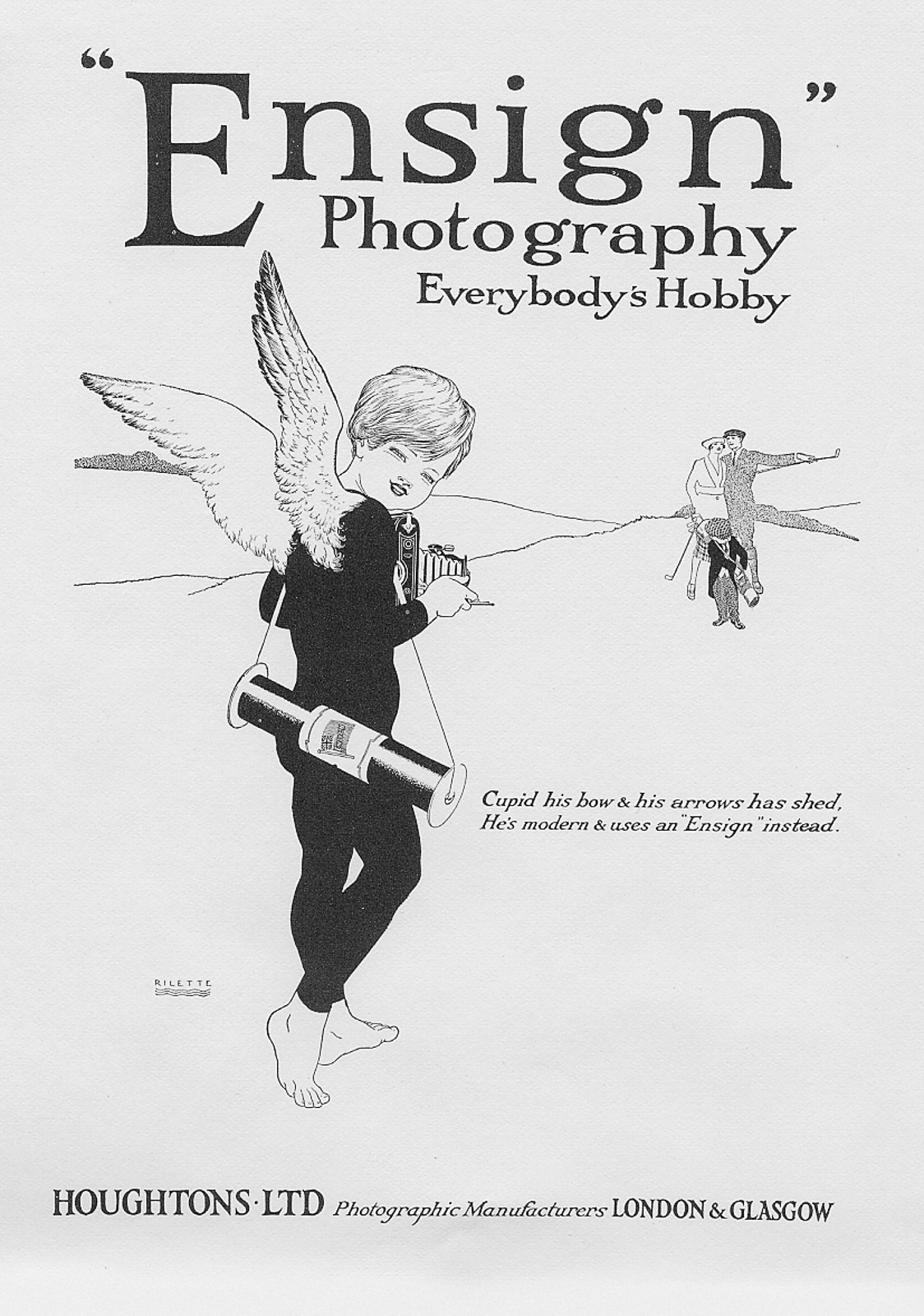
Another oddity is the name Houghtons chose for the camera, The Cupid, or so it would seem, however if you look at Houghtons adverts around the nineteen twenties it becomes apparent why they adopted such an unusual name. Cupid features strongly in Houghtons' advertising at this time forming the theme for a whole series of adverts in newspapers and magazines drawn by an artist called Rillette. (see advert)
The camera underwent few alterations in its lifetime the only significant variation being the introduction in its later life of some coloured versions, a light grey and a silver model. The Cupid was originally supplied in a leather case with space for four extra films either side of the lens and in 1923 cost 18s 6d. The only accessory advertised for use with the camera was a clip-on reflecting view finder which originally cost 2s 6d. However, by 1927 this accessory was being offered free with the camera, case and three spare films for just 15s. Although never advertised, a close-up lens attachment was also available for the Cupid. Specially designed to clip around the cameras pointed nose, it allowed for portraits to be taken at a distance of between 3 and 9 feet.
In 1927 Houghton-Butcher abandoned their attempt to modernize the box camera and returned to a more traditional design with the introduction of what was to become a very popular camera, the "All distance" Ensign box. Like the Cupid it was all metal in construction with the same crackle finish. This was a no-nonsense rectangular box camera but with the added feature of an adjustable lens that
allowed close up photography without the need for supplementary lenses.
In 1937 Ensign Ltd. (as the company was now called) did produce however another 16 on 120 box camera, the Ensign E-20 camera. Again, a simple pressed metal box camera but with the added feature of double exposure prevention. The Cupid continued to be listed in the E20 roll film tables until 1939, the exact date of its withdrawal unknown and even though I now understand how it came to be developed, for me it is still a very quirky design, perhaps that's what makes it so interesting?
1 The Houghton Butcher Manufacturing Company Ltd. designed and manufactured Ensign cameras which were sold by Houghtons Ltd.
2 All patents courtesy British Patent Office.
COMPANY CHRONOLOGY COVERING THIS PERIOD
1904 Houghtons Ltd.
1915 British Photographic Industries set up by Houghtons and W. Butcher & Sons Ltd. with joint manufacturing. Both companies trade under their original names until 1926.
1926 Houghton-Butcher (GB) Ltd.
1930 Ensign Ltd. floated, the manufacture of cameras continued at the old H.B.M.Co.Ltd. works, Walthamstow. Ensign cameras were sold from the old Houghtons premises in Holborn, London.
SELECT BIBLIOGRAPHY
1 Collecting Old Cameras, Permutt Cyril, Angus & Robertson, 1976.
2 Ensign Photographic Catalogues, various dates.
3 Cameras, Coe Brian, Marshall Cavendish, 1978.
4 Catalogue of 'The Cyril Permutt Collection Of Cameras, Optical toys and related material', Christie's South Kensington, 1988.
5 Progressive Photography, W.L.F. Wastell, Houghtons Ltd., c 1923.